IN USE / ONGOING / Private creator research automation suite
InfluencerSystems
Seven focused tools that discover, normalize, evaluate, and hand off creator candidates across Instagram, TikTok, and YouTube.
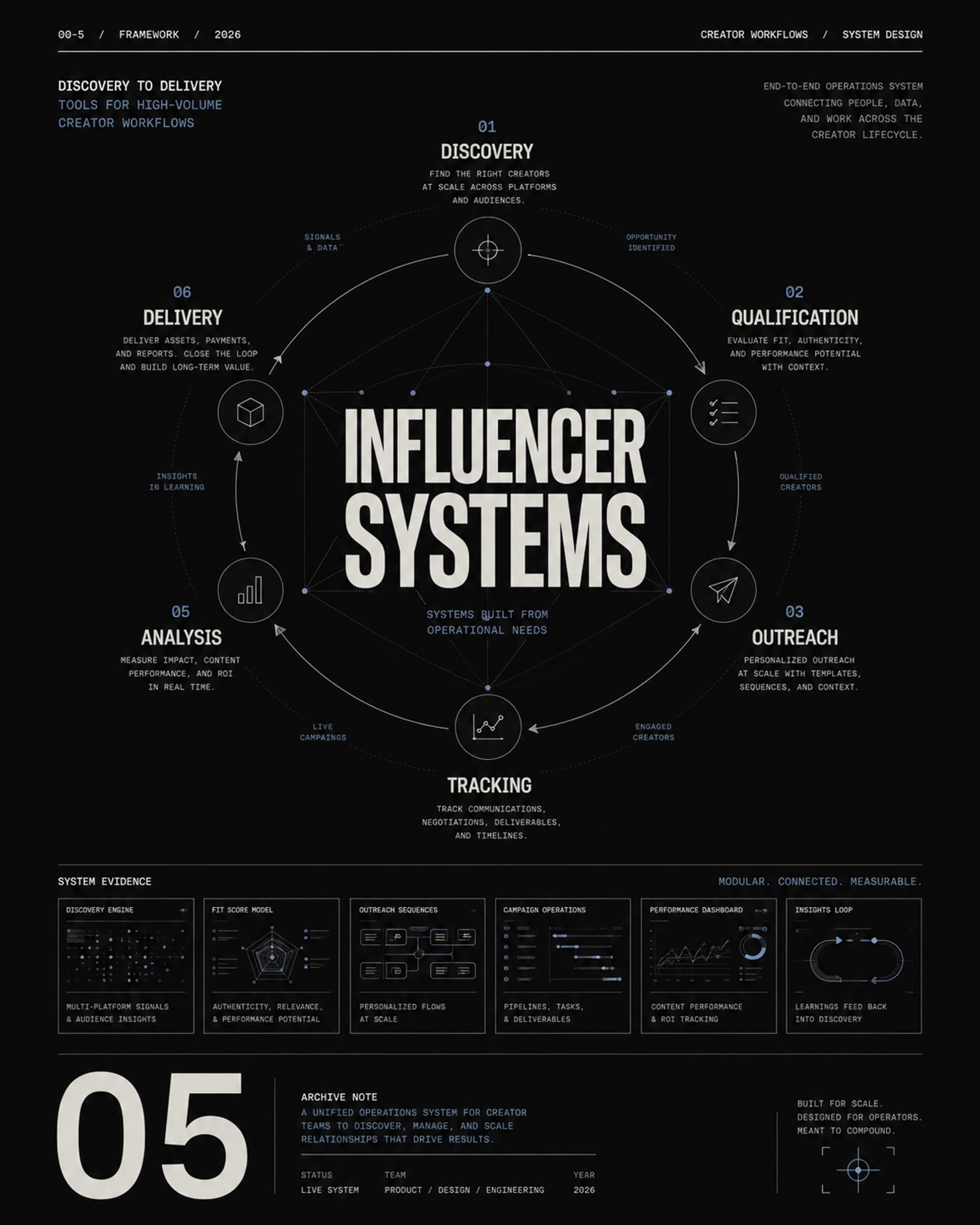
- Three platforms enter one local queue.
- Normalize identity before making a judgment.
- Keep observable evidence separate from decisions.
- Checkpoints preserve partial work through platform failures.
- Export review-ready records, never a hidden send action.
Workflow architecture, browser automation, local data tooling, rule design, and daily operation.
IN USE
PRIVATE / CLOSED SOURCE
SEVEN TOOLS. CLEAR HANDOFFS. ONE SYSTEM.
PROBLEM
Creator research was repeatedly rebuilt from browser tabs, copied handles, inconsistent exports, and platform-specific checks. A useful candidate could be lost between discovery and review, while a previously handled account could quietly re-enter the queue.
SOLUTION
I built seven narrow local tools with explicit handoff contracts. Each tool owns one job, preserves its source, records uncertainty, and passes a reviewable artifact forward. Official APIs are used where practical; DOM-assisted steps remain bounded, recoverable, and private.
INTERACTIVE SYSTEM MAP / FICTIONAL DATA ONLY
TRACE THE HANDOFF, NOT THE PRIVATE CODE.
Follow one fictional creator record across four public-safe stages.DISCOVER
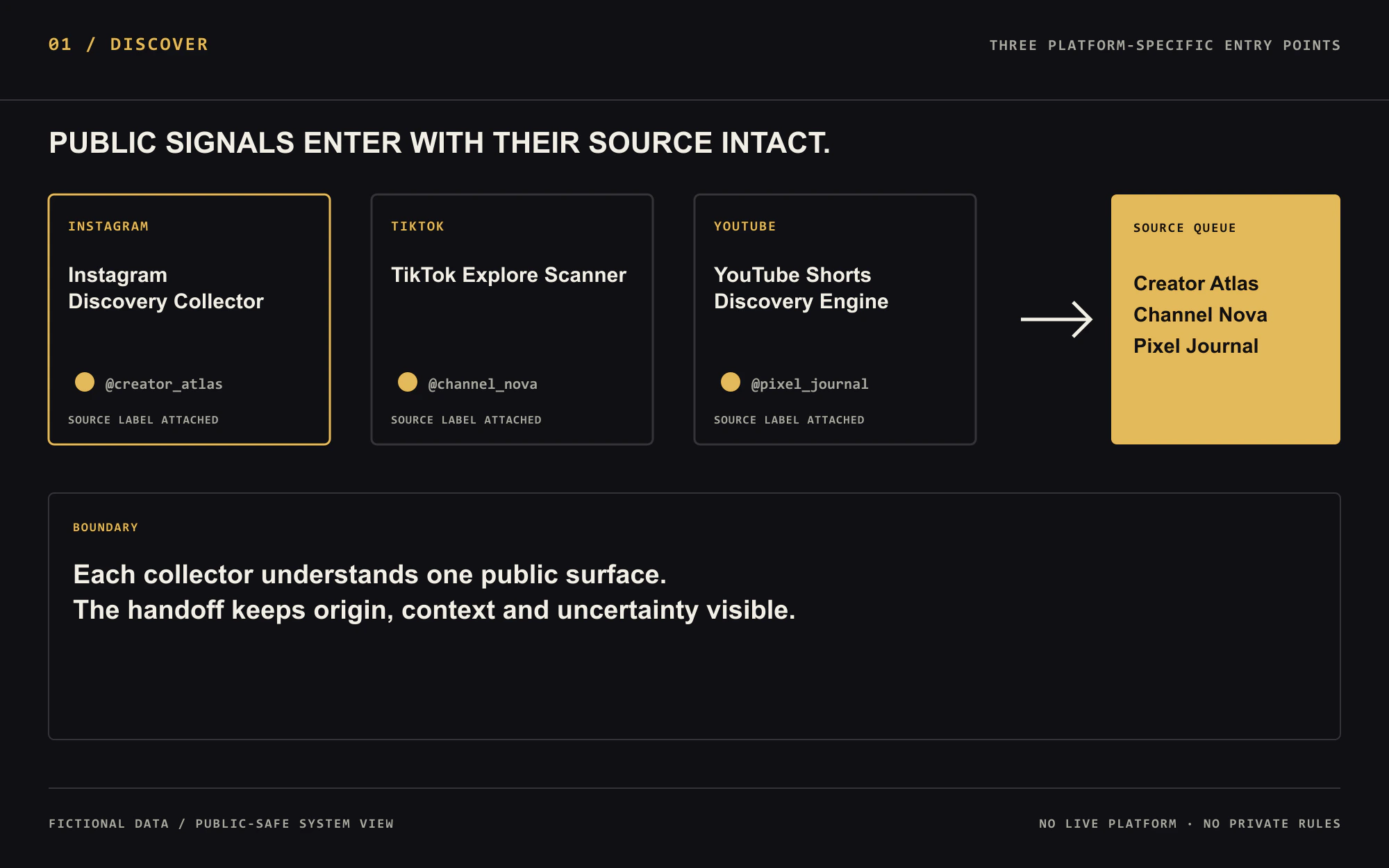
Collect public creator signals without pretending every platform exposes the same surface.
- INPUT
- Keywords, seed accounts, Shorts, Reels, and platform search results.
- OUTPUT
- A source-labelled queue of fictional candidate handles.
- BOUNDARY
- No login state, private profile data, or live platform request is used in this demo.
Creator Atlas observed as @creator_atlas from a public discovery surface.
DISCOVERNORMALIZEEVALUATEHANDOFF
- 01
Collect public signals from keywords, seed accounts, Shorts, Reels, and platform search surfaces.
- 02
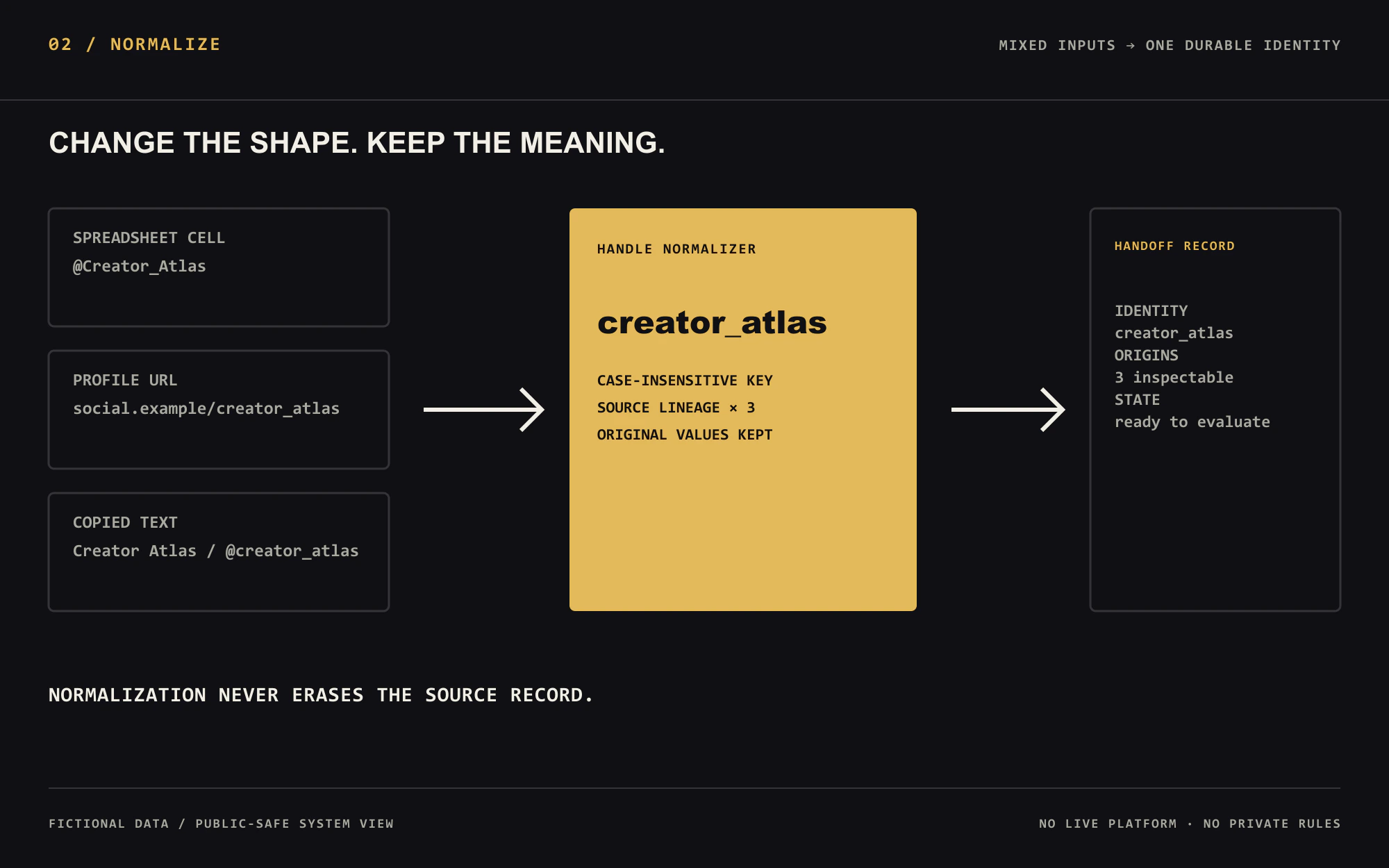
Normalize handles from tables, profile URLs, and free text while retaining source lineage and removing duplicates.
- 03
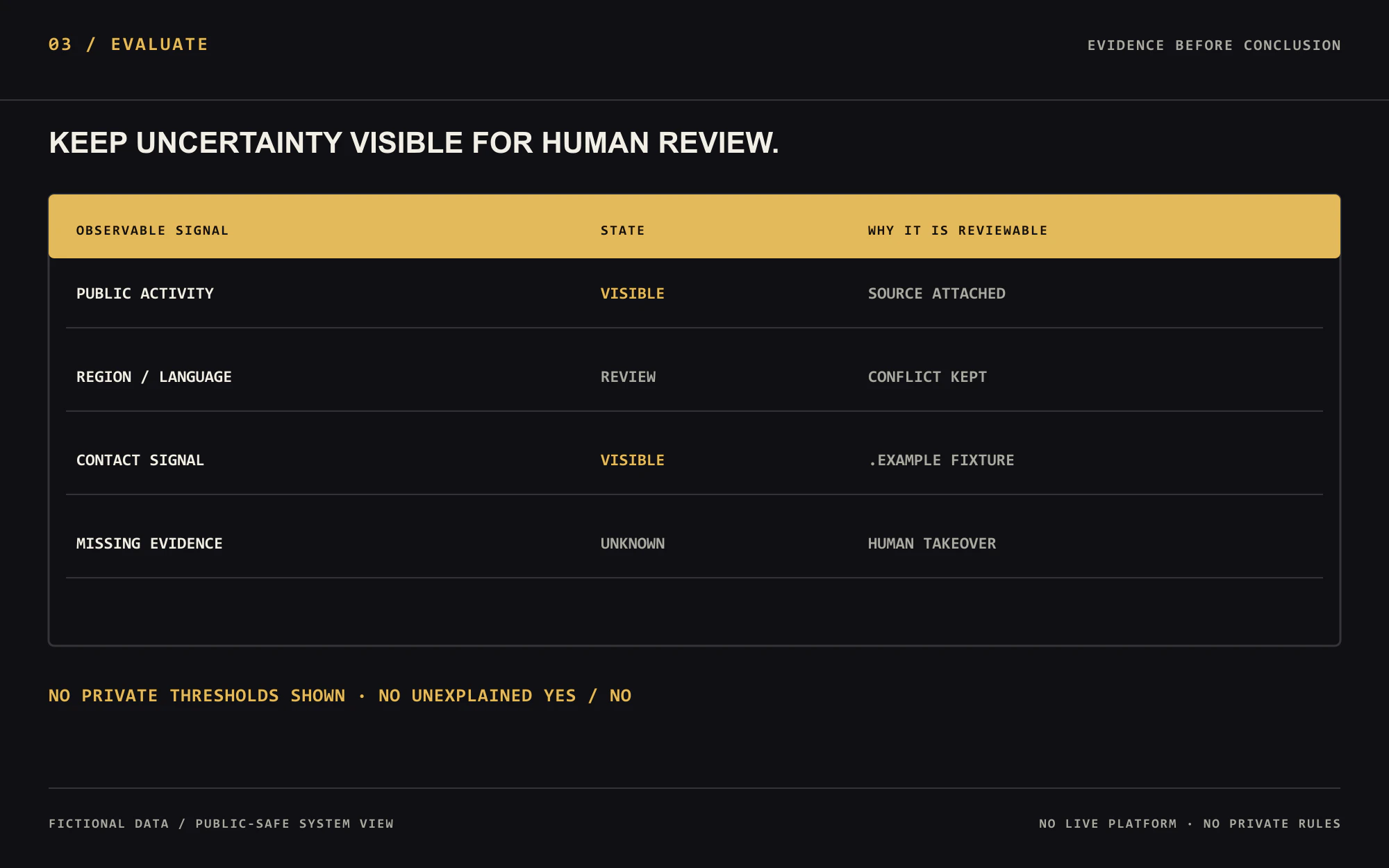
Attach platform-specific public evidence. Missing or conflicting signals are routed to review instead of being guessed.
- 04
Hand off TXT, CSV, XLSX, or JSON artifacts with checkpoints and local duplicate ledgers for the next private system.
Discovery adapters cover Instagram, TikTok, and YouTube without forcing every platform into the same collection method.
A local normalizer extracts handles from explicit columns, profile links, and embedded text, then deduplicates case-insensitively.
Platform evaluators keep observable evidence separate from the decision and preserve reasons for later review.
Long-running queues checkpoint locally and surface quota, unavailable-page, and interrupted-worker states for manual recovery.
Export history and local identity ledgers prevent previously handled creators from silently returning to a new queue.
DOM-assisted steps are explicitly treated as fragile boundaries: missing data pauses, degrades, or requests review instead of fabricating certainty.
BEFORE → BUILT → AFTER
Discovery, copying, cleanup, platform checks, and export were repeated by hand, with no durable contract between steps.
Seven working local utilities now cover three platforms. In the current engineering snapshot, the YouTube path passes 14 automated tests and the Instagram batch screener passes its TypeScript check.
Candidates can move through repeatable, reviewable handoffs without exposing private repositories or claiming real-list volume and business KPIs.
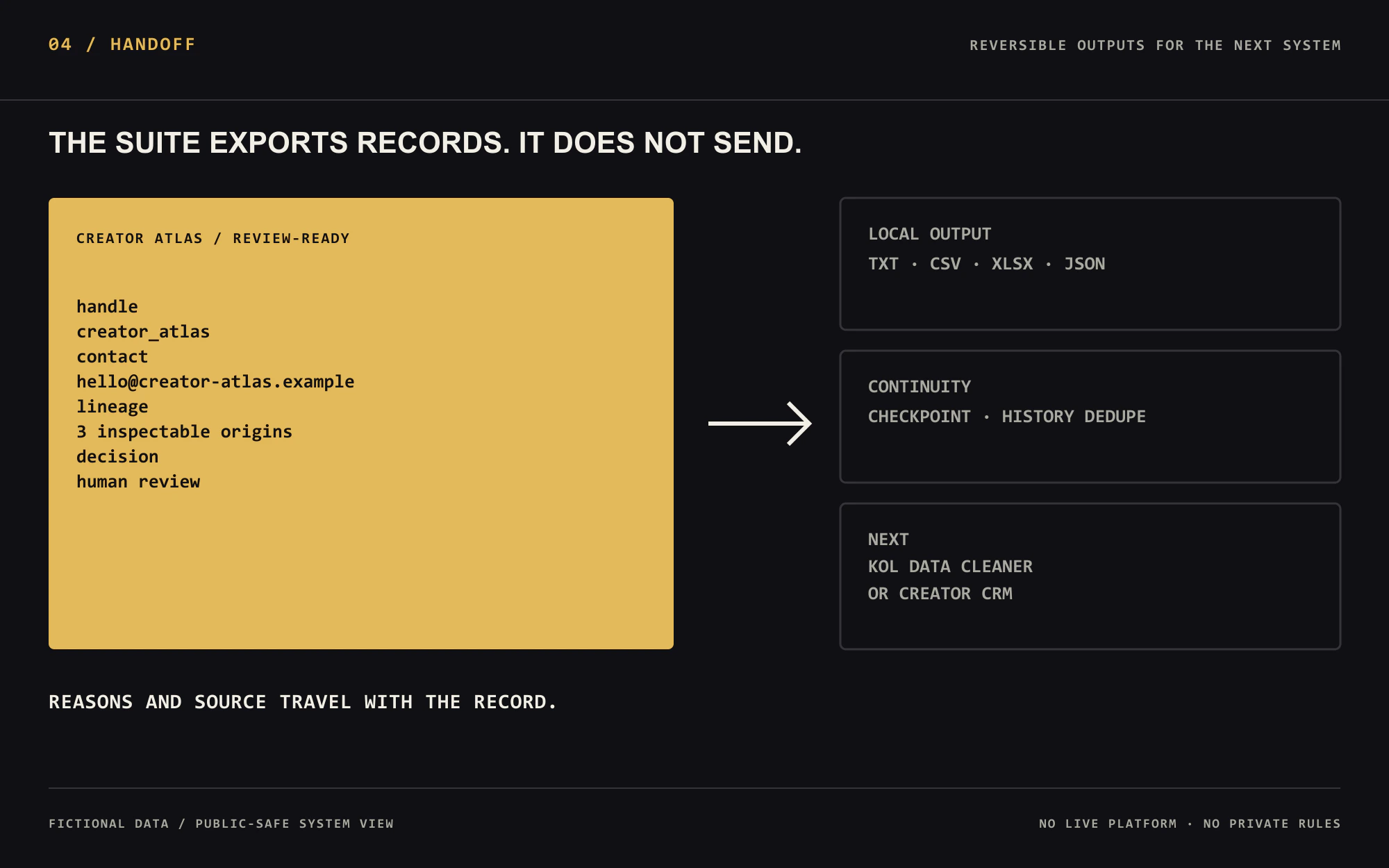
Automation becomes a system when failure states and handoffs are designed as carefully as the happy path. Small tools compound because each output remains understandable outside the tool that produced it.
Replace fragile DOM dependencies with official APIs where feasible, add fixture-based DOM contract tests, version rule packs, converge on one handoff schema, and review platform terms and UI dependencies before any commercial packaging.
PRIVATE SYSTEMS
[ CLOSED SOURCE ][ CONTACT ↗ ]